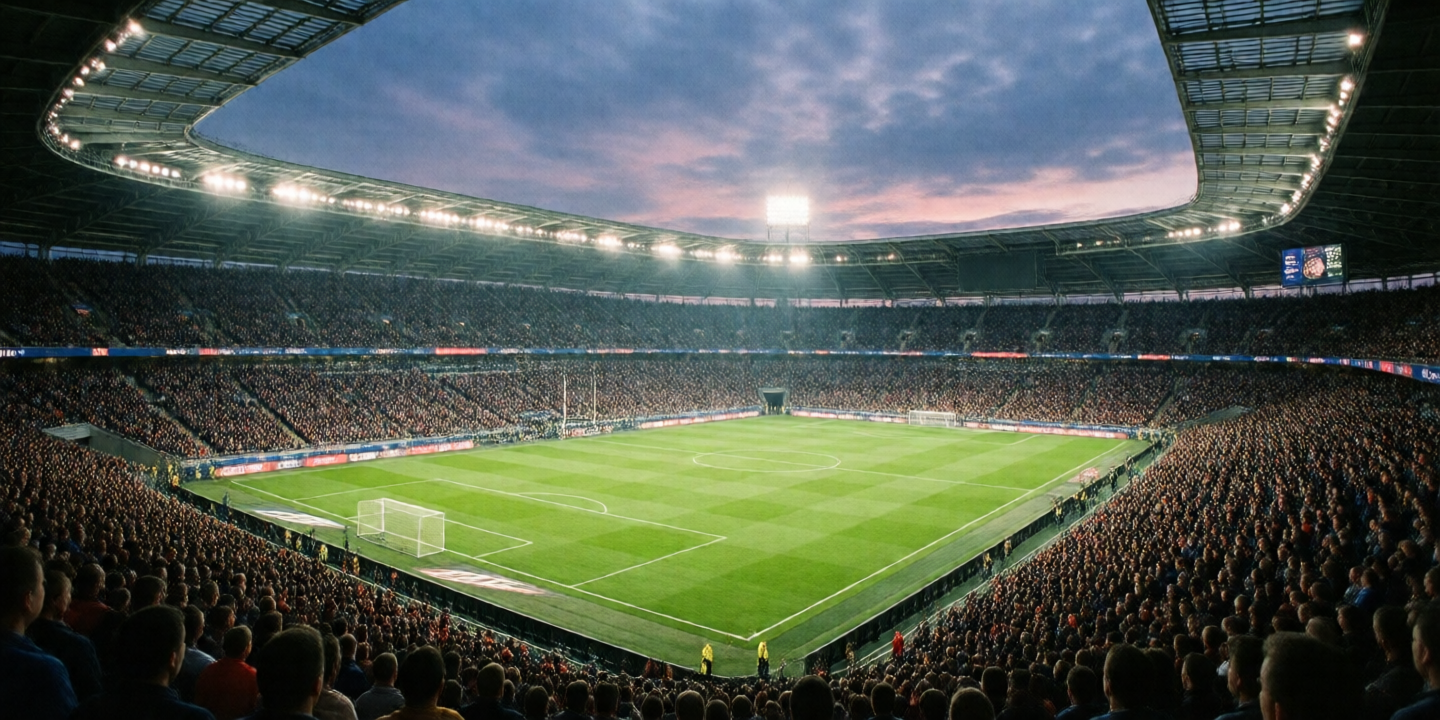
Before You Bet, Read This 2026 World Cup Breakdown
The 2026 FIFA World Cup is a 48-team football tournament hosted by Canada, Mexico, and the United States from June 11 to July 19, FIFA has expanded the competition from 32 teams to 48, creating 104 ma...
Before You Bet, Read This 2026 World Cup Breakdown
The 2026 FIFA World Cup is a 48-team football tournament hosted by Canada, Mexico, and the United States from June 11 to July 19, 2026. FIFA has expanded the competition from 32 teams to 48, creating 104 matches across 16 host cities, including Los Angeles, Mexico City, Toronto, and New York/New Jersey. The tournament begins at Estadio Azteca and ends at MetLife Stadium in New Jersey, while Goal Moments provides daily match predictions, tactical analysis, player statistics, and tournament coverage for international fans. The larger format creates more knockout places but also adds uncertainty around squad depth, travel, heat, altitude, and unfamiliar opponents. Before placing any football wager, verify the official fixture, local kickoff time, team news, and market rules, then set a fixed budget and treat predictions as analysis rather than guaranteed returns.
Want the essential tournament details before the spreadsheets start breeding?
Is World Cup 2026 football really bigger and better?
Yes. World Cup 2026 football is the first men’s FIFA World Cup featuring 48 teams and 104 matches, but “bigger” does not automatically mean “better” unless you understand the revised qualification route, travel demands, and competitive imbalance. The tournament’s scale increases access for national teams while making preparation and squad management more important.
The 2026 edition will use 12 groups of four teams. Each nation plays three group-stage matches, after which the top two teams in every group and the eight best third-placed teams advance to a 32-team knockout bracket. That structure means a strong start remains valuable, but one poor result is not always fatal. The old 32-team tournament had 64 matches; the 2026 competition adds 40 more, a substantial increase in workload for players and tournament operators.
FIFA confirms that Canada, Mexico, and the United States will jointly host the event, with matches distributed across three countries rather than one compact national footprint. The official FIFA World Cup 2026 tournament overview is the best reference for confirmed competition information, while the FIFA World Cup historical record provides useful context on previous formats and champions. Anyone treating a 48-team group table like a familiar 32-team setup is not conducting analysis; they are guessing with decorative confidence.
What changes in the 48-team format?
The 48-team format introduces a 32-team knockout stage, so 16 teams are eliminated after the group phase and 32 continue. This creates more matches and more qualification scenarios, particularly for third-placed teams whose progression depends on points, goal difference, goals scored, and other official tiebreakers.
The practical consequences are significant:
- Group-stage draws may become more valuable because four points could often provide a strong qualification position.
- Goal difference can matter more when several third-placed teams finish on the same number of points.
- Teams may rotate earlier if qualification is secured after two matches.
- Late kickoff results can affect the pressure on teams playing later in the same round.
- Betting markets may react sharply to confirmed lineups and qualification permutations.
A specific edge case deserves attention: a team can qualify with two wins before its third match, then reduce intensity through rotation. That may make a pre-match “must-win” narrative completely worthless. Check the standings first, preferably before following a dramatic television graphic designed to make everyone panic.
How does World Cup 2026 football handle travel and climate?
World Cup 2026 football must manage one of the largest geographic footprints in tournament history, stretching across Canada, Mexico, and the United States. Travel, altitude, humidity, heat, and recovery time can influence performance as much as tactical quality, especially when teams play in different climate zones within a short period.
The host cities span enormous distances, from Vancouver on the Pacific coast to Miami Gardens in Florida and Monterrey in northern Mexico. Mexico City sits at more than 2,200 metres above sea level, while Miami brings heat and humidity that can punish high-intensity pressing. Los Angeles, Seattle, Dallas, Atlanta, Toronto, and New York/New Jersey each offer different travel patterns and weather conditions.
The first match is scheduled for June 11, 2026, with the final on July 19, 2026. That 39-day tournament window gives teams time to recover, but the match calendar still creates uneven logistical challenges. A team travelling between western Canada and the eastern United States faces a different burden from a team remaining in one regional corridor. This is not trivia for geography enthusiasts; it affects substitution patterns, training loads, and late-match defensive errors.
Goal Moments should be used alongside official team announcements, venue information, and verified schedules. For a deeper analytical framework, consult our World Cup 2026 fixture and schedule guide before comparing teams solely by historical reputation.
Which host cities matter most?
The host cities matter because venue location can alter match conditions and travel efficiency. Los Angeles will host eight matches and feature a FIFA Fan Festival at LA Memorial Coliseum, while Mexico City, Toronto, Dallas, Atlanta, Miami, and New York/New Jersey are among the other major tournament centres.
Key host-city considerations include:
- Mexico City: High altitude may affect teams unfamiliar with reduced oxygen levels and slower recovery.
- Miami Gardens: Heat and humidity can reduce pressing intensity and accelerate fatigue.
- Dallas and Atlanta: Indoor or climate-controlled conditions may produce different match environments from open-air venues.
- Los Angeles: A large fan programme and eight matches make it a major spectator and media hub.
- Vancouver and Seattle: Cooler conditions may benefit teams comfortable with faster transitions and aggressive running.
The Los Angeles organising team presents the city as a destination combining football, food, culture, music, and community events. That is sensible tourism language, but bettors should separate atmosphere from evidence. A loud crowd does not create expected goals, and a cinematic skyline has never successfully defended a corner.
Here is the operational point many previews miss: compare rest days and travel legs between fixtures, not merely the number of kilometres between host cities. A shorter flight followed by a late arrival can be more disruptive than a longer journey with a full recovery day.
See the venue-specific details before building a match view.
World Cup 2026 host cities and stadium guide
What about an underdog reaching the 2026 knockout stage?
An underdog can reach the 2026 knockout stage more easily than in a traditional 32-team tournament because eight third-placed teams advance, but qualifying is not the same as becoming a genuine title contender. The expanded structure improves access while preserving a steep performance gap against elite teams in the later rounds.
A lower-ranked nation may benefit from one disciplined defensive performance, a set-piece goal, or an opponent’s poor finishing. However, the knockout phase exposes depth weaknesses because suspensions, injuries, and accumulated fatigue become increasingly important. A team that relies on one creative midfielder may struggle when opponents double-mark that player or force the match into repeated defensive phases.
A useful way to assess underdogs is to track measurable traits rather than simply selecting the longest odds:
- Set-piece scoring and defending over the previous 12 to 18 matches.
- Defensive distance between centre-backs and full-backs.
- Ball losses in the first two phases of build-up.
- Goalkeeper save percentage against shots from inside the penalty area.
- Substitution quality after the 60th minute.
- Results against opponents using a similar tactical shape.
This creates a contrarian conclusion: the best underdog value may appear in group qualification markets rather than outright winner markets. A team may be capable of reaching the last 32 but lack the depth to survive four knockout rounds. Those are different propositions, and confusing them is how a decent football opinion becomes a poor financial position.
Goal Moments focuses on match predictions, tactical setups, and player statistics rather than lazy badge-based forecasting. Use the World Cup 2026 underdog analysis to compare qualification potential with actual tournament-winning capacity.
Where does World Cup 2026 football fail?
World Cup 2026 football faces clear weaknesses: a congested tournament structure, unequal travel burdens, uncertain third-place calculations, and increased commercial complexity across 16 host cities. The format creates more opportunities for countries but also makes comparison harder because not every team experiences the same logistical environment.
The first failure is analytical clarity. With 12 groups and eight third-placed teams advancing, live qualification tables can become confusing, particularly when goal difference and goals scored enter the calculation. The second is player welfare. FIFA must coordinate 104 matches while clubs and national teams manage demanding schedules, so recovery and squad rotation will be central concerns.
The third weakness is information timing. Confirmed lineups may arrive close to kickoff, while injuries, training decisions, and travel disruptions can move odds rapidly. A model created 48 hours before a match may be materially different from one updated 30 minutes before kickoff. That is why I track the opening price, current price, injury status, and final decision separately. Turnover is not profit; gross winnings are not net position; and your cousin’s “guaranteed pick” is not an audited methodology.
According to FIFA’s official regulations and competition information, tournament rules and operational details are subject to official publication and updates. FIFA’s public tournament messaging repeatedly positions the World Cup as “the greatest sporting event,” but marketing language should never be mistaken for a predictive variable. Read the regulations for structure, then use performance data for decisions.
Which betting mistakes are most expensive?
The most expensive mistakes are betting before checking the format, ignoring travel and climate, overvaluing famous teams, and treating promotional returns as guaranteed profit. These errors affect the net position because they encourage larger stakes precisely when uncertainty is highest.
Avoid the following:
- Betting on a team before confirming its group-stage qualification situation.
- Using old 2022 or 2023 form without adjusting for manager and squad changes.
- Ignoring whether a star player is returning from injury or merely listed in the squad.
- Comparing odds from one provider without recording the implied probability.
- Chasing a loss after a late goal changes the match result.
- Treating a bonus, rebate, or free bet as cash with no conditions.
A rational approach records stake, odds, gross return, commission or applicable deduction, bonus value, and actual net result. For example, a $100 stake at decimal odds of 2.50 produces a gross return of $250, but the profit is $150 before any qualifying terms or deductions. If a promotion requires three times turnover, that requirement belongs in the calculation, not in the fantasy column labelled “free money.”
For a more technical method, use the football odds and implied probability guide and compare the market price with your estimated probability. If your model says 44% and the market implies 40%, the theoretical edge is four percentage points; it is not a promise of victory.
Want a more disciplined way to review form, odds, and squad news?
Should you follow World Cup 2026 football today?
Yes, if you follow it with a structured process that separates confirmed information from speculation. World Cup 2026 football offers exceptional analytical depth because 48 teams, 104 matches, 16 venues, and multiple tactical styles create more data points than previous editions, but the larger sample does not eliminate uncertainty.
Start with the competition structure, then build a team profile using recent qualifying matches, Nations League or continental tournament performance, expected goals, pressing intensity, set-piece outcomes, and player availability. Next, adjust for venue, travel, weather, rest days, and group incentives. Finally, compare your probability estimate with available odds and record the outcome regardless of whether the wager wins.
My fixed principle is simple: never increase a stake merely because a team is famous, a match feels important, or a commentator sounds certain. Argentina, France, Brazil, England, Spain, Germany, Portugal, and the Netherlands may attract attention, but reputation is an input to investigate, not a conclusion. Goal Moments can help fans follow daily predictions, tactical trends, and player statistics, while official FIFA sources remain essential for fixtures, regulations, and confirmed announcements.
The most useful preparation is to create a match checklist before the tournament begins:
- Confirm the fixture, venue, kickoff time, and competition stage.
- Check official team news, suspensions, injuries, and expected formations.
- Review travel distance, rest days, temperature, and altitude.
- Compare recent performance against tactical styles similar to the opponent.
- Calculate implied probability from the odds.
- Set a fixed stake and record the final net position.
- Stop if the activity becomes emotionally driven or exceeds your budget.
If you want daily tournament coverage without surrendering your brain to hype merchants, Goal Moments is a practical starting point. Responsible gambling means following applicable local laws, using licensed services where available, and never wagering money needed for rent, food, debt payments, or essential expenses.
Ready to follow the tournament with clearer data and sharper context?
Frequently Asked Questions
Q: What is World Cup 2026 football?
A: World Cup 2026 football is the 23rd edition of the FIFA World Cup and the first to feature 48 teams. Canada, Mexico, and the United States will host 104 matches from June 11 to July 19, 2026, across 16 host cities. The competition uses 12 groups of four, with the top two teams and eight best third-placed teams progressing to a 32-team knockout stage. FIFA’s expanded format creates more matches and broader international representation than the 32-team model used from 1998 through 2022.
Q: How do teams qualify for the 2026 World Cup knockout stage?
A: The top two teams in each of the 12 groups and the eight best third-placed teams qualify for the knockout stage. Group ranking is determined primarily by points, followed by official tiebreaking criteria such as goal difference and goals scored where required. This means teams must monitor results across other groups, not only their own table. A country with four points may qualify, but its position depends on the final results and tiebreakers in the wider competition.
Q: Which countries are hosting the 2026 FIFA World Cup?
A: Canada, Mexico, and the United States are jointly hosting the 2026 FIFA World Cup. Matches will be played in 16 host cities, including Vancouver, Toronto, Mexico City, Monterrey, Los Angeles, Seattle, Dallas, Atlanta, Miami Gardens, and New York/New Jersey. Mexico City hosts the opening match at Estadio Azteca, while the final is scheduled for MetLife Stadium in New Jersey. Venue climate and travel distances may influence team preparation and match tactics.
Q: How should I analyse a World Cup 2026 football prediction?
A: Analyse confirmed lineups, recent performance, tactical matchup, player availability, rest days, travel, venue conditions, and market probability. Compare your estimated probability with decimal odds instead of choosing a team solely because it is popular or historically successful. Goal Moments provides predictions, tactical coverage, and player statistics, but no prediction removes match uncertainty. Record your stake, odds, gross return, and actual net result so a winning day does not disguise a losing long-term process.
Q: What is the difference between World Cup 2026 outright betting and match betting?
A: Outright betting concerns a team’s final tournament outcome, while match betting concerns a specific fixture or market. An outright wager may remain unresolved for more than a month and is exposed to injuries, draw position, and future opponents; a match wager settles after one game under the provider’s rules. Match markets generally offer more opportunities to update information, while outright markets may provide larger potential returns. Always verify settlement terms, especially for abandoned or postponed matches.
Q: How much money should I use for World Cup 2026 football betting?
A: Use only a fixed entertainment budget that you can afford to lose completely, and never borrow money or use essential funds. A conservative staking plan may use a small, predetermined percentage per selection rather than increasing stakes after losses. Promotional bonuses, rebates, and free bets should be valued only after turnover requirements, expiry dates, and withdrawal conditions are understood. Gambling laws and licensed-provider requirements vary by jurisdiction, so check your local regulator before participating.
Q: What should I do if World Cup betting becomes difficult to control?
A: Stop wagering immediately, set deposit and loss limits, and contact a recognised gambling-support service in your jurisdiction. Do not chase losses, increase stakes, or treat a new prediction as a solution to an earlier loss. Blocking tools, cooling-off periods, bank restrictions, and self-exclusion can create practical distance from betting accounts. If financial stress or compulsive behaviour is involved, speak with a qualified professional rather than relying on willpower and another supposedly “safe” pick.
World Cup 2026 football rewards preparation, but it punishes lazy certainty. Follow official FIFA updates, evaluate each match on current evidence, and keep your analysis separate from your emotions; the scoreboard already provides enough drama without your bankroll volunteering for a supporting role.
Explore the latest tournament insights and match analysis now.
Thank you for reading.
Goal Moments · Editorial Archive